01
Catalogue, your brand
Kettlebells, dumbbells and plates from existing tooling. Logo cast into the body, your colour, your carton. The fastest and cheapest way to test a market.
Four ways to work with us, from putting your logo on a catalogue kettlebell to building a new housing from a drawing. All of them run through the same quotation sheet, the same first-article gate and the same shipping desk — because the fastest way to lose a customer is to let a small order skip a step.
Most first orders start at 01 or 03 and move inward later. There is no penalty for starting small — but there is a real cost in pretending a drawing is ready when it is still a sketch.
Kettlebells, dumbbells and plates from existing tooling. Logo cast into the body, your colour, your carton. The fastest and cheapest way to test a market.
Same body, different handle, weight step, colour code or marking. A new core box rather than a new pattern — most of the tooling cost stays on the shelf.
Automotive and industrial castings, as-cast or fully machined. Pattern and core box quoted per part number, first article signed before volume.
You bring the function, we bring the casting rules: wall thickness, draft, fillet, machining allowance. Cheaper than fixing a design after the first pour.
Step 05 and step 06 are not formalities. Nothing moves to volume until the first article is measured, written down and signed — for a 4 kg kettlebell and for a steering housing alike.
A drawing, a sample photo, or a weight and a finish. Enough to know which line it belongs to.
Within two working days: material grade, moulding route, cores, machining sequence, and the risks we see.
Broken down by part number: material, labour, tooling, finish, packing and freight — not one blended number.
Off the production tool where possible, so what you approve is what the line will make.
Full-dimension report, CMM print on critical bores, weight and finish checked. Gate one.
You sign the report or mark it up. Revisions go back through step 04, not straight to the line. Gate two.
Heat number recorded, casting and machining scheduled together so the parts are not waiting on each other.
Packing list, inspection record and heat trace in the file. Carton marks to your artwork, container loaded to weight.
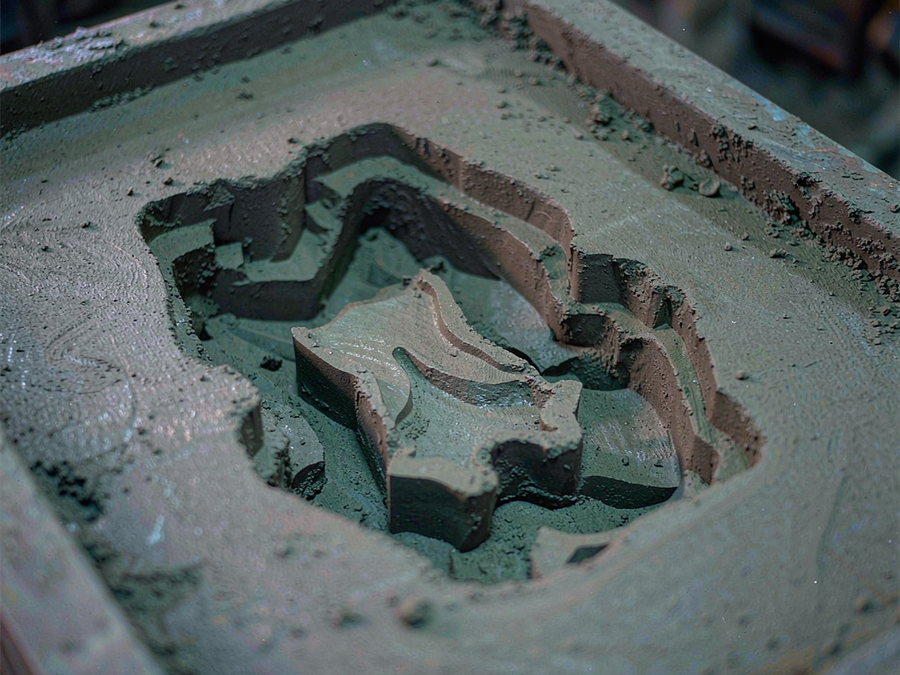
A pattern, a core box and any machining fixture are quoted as separate lines against the part number. That way you can see what is a one-off cost and what is a per-piece cost, and decide which weight steps are worth extending this year.
We will tell you if a draft angle, wall thickness or corner radius is going to fight the process. Changing it on paper costs nothing; changing it after the first pour costs a pattern.
Ownership of tooling, who stores it and for how long are written into the contract before the first production order. We would rather agree it in the open than argue about it in year three.
Competition kettlebells share one outer body across the whole weight range; only the core changes. That is why adding a weight step later is a core box, not a new pattern.
A container of kettlebells runs out of payload long before it runs out of space. That single fact decides the packing plan, the mix and the freight per kilo — so it belongs in the quotation, not in a surprise at the port.
| Item | What we do by default | What can change |
|---|---|---|
| Inner packing | Bulk in poly-lined carton, one piece per sleeve for coated goods | Colour box, brown box, display-ready tray |
| Outer packing | Export carton with shipping mark, edge protectors on heavy items | Palletised, shrink-wrapped, or floor-loaded to weight |
| Container plan | Mixed free-weight loads, planned to payload rather than to floor area | Single-SKU loads for simpler customs and counting |
| Marking | Your logo, barcode and carton number as supplied artwork | Weight and colour code printed on the carton |
| Loading port | FOB Wuhan or Shanghai; Xianning is ~120 km from Yangluo | CIF, or EXW if you use your own forwarder |
| Documents | Packing list, invoice, inspection record, heat-number trace | Certificate of origin, third-party inspection on request |
We are not going to publish a price list that is wrong for every part number. Here is the shape of the deal instead — the parts that stay the same regardless of what you order.
| Topic | Default position | Open to discussion |
|---|---|---|
| Quotation | Per part number, split into material, labour, tooling, finish, packing | Consolidated price if you prefer one number |
| MOQ | Set by whether tooling exists, not by a blanket figure | Trial quantity on a new programme |
| Tooling | Separate line, ownership and storage written into the contract | Amortised across the first orders |
| Payment | T/T, terms fixed in the contract before production | L/C for established programmes |
| Inspection | First article plus batch record, both in the file | Third-party inspection; you are welcome to attend |
| Claims | Contain in 1 day, investigate in 3, written disposition in 5 | Replacement, rework or credit — your call |
Answered here so the first email can be about your part instead of our paperwork.
If the part is not ready to draw, send a photo and the application. Telling you it is not a casting job yet is also a useful answer.